Russell Joseph, Senior Group Controls Manager at Luceco, looks at how lighting controls have gone from optional extra to essential specification.
Lighting has undergone a fundamental change in recent years. The move from conventional lamps to increasingly efficient LED technology has transformed the performance and flexibility of luminaires, but the next stage of that evolution is taking place beyond the light source itself. Increasingly, it is the way lighting is controlled that is determining how effectively a building performs.
For electrical wholesalers, this represents an important shift in the lighting proposition. Customers are no longer simply looking for luminaires that provide the required level of illumination. Contractors, consultants, facilities managers and building owners are increasingly considering how lighting can respond to occupancy, available daylight, operating schedules and changing patterns of building use and that is putting lighting controls firmly into the mainstream.
In particular, wireless technology is helping to remove some of the barriers that have historically limited the adoption of more sophisticated control systems. With Bluetooth Networked Lighting Control (NLC) technology providing a recognised foundation for connected lighting, intelligent control can now be introduced without the additional control wiring traditionally associated with many systems. For contractors, that can mean a simpler installation and for wholesalers, it creates an opportunity to provide a more complete lighting solution.
Changing the lighting proposition
The growth of LED has already changed expectations around lighting. Today’s luminaires can deliver high levels of efficiency, improved optical performance and greater flexibility, but simply installing efficient products does not necessarily maximise the potential energy savings available from a lighting installation. Controls provide the means to make lighting more responsive.
Presence detection, for example, can ensure that lighting is reduced or switched off when an area is unoccupied, while daylight harvesting can adjust artificial lighting according to the amount of natural light available. Scheduling, dimming and scene setting can further match lighting output to the way a space is being used.
Increasingly relevant across a wide range of applications, from offices and education facilities to warehouses, retail environments and industrial buildings, the result is a move away from lighting as a static service towards lighting as an intelligent building system.
Luceco’s Platform Wireless Lighting Controls system has been developed around this principle. Based on the Bluetooth NLC standard, Platform uses a wireless mesh network to connect luminaires, sensors, switches and gateways, creating a connected lighting infrastructure without the requirement for dedicated control cabling.
Removing complexity from installation
One of the most significant developments in wireless control is that it is no longer simply being viewed as a convenience for smaller or less demanding installations. With particular implications for refurbishment and retrofit work, Bluetooth NLC technology provides a foundation for professional commercial applications, with networked devices communicating across an installation through a mesh architecture.
Whilst running additional control cables through an occupied building can introduce significant practical challenges – access above ceilings may be restricted, disruption to occupants needs to be minimised and project costs can increase when additional wiring and associated infrastructure are required – a wireless approach can simplify that process, allowing control functionality to be introduced while making better use of existing electrical infrastructure.
This does not mean that wireless control is appropriate for every application, but it gives contractors another option when designing a system – particularly where flexibility, speed of installation and minimal disruption are priorities.
For the wholesaler, that flexibility is also significant. A lighting project can increasingly encompass the luminaire, control system, sensors and associated connectivity, rather than treating controls as a separate specialist consideration.
Value beyond installation
The benefits of networked lighting do not end when the installation is commissioned. Once a lighting system is connected, it can provide building operators with greater visibility of how lighting is being used. Monitoring and management tools can help identify operating patterns and provide information that can be used to optimise the system over time and that’s particularly important as organisations look beyond initial installation costs and consider the total cost of ownership of a building.
Energy efficiency is one part of this equation. There is also the question of how adaptable a building needs to be over its lifetime. Office layouts change, warehouse operations evolve, retail spaces are remodelled, educational buildings are reconfigured. In each case, lighting requirements can change with them.
A networked wireless system can provide flexibility that is difficult to achieve with a conventional fixed control arrangement. Zones can be configured and adjusted digitally, while additional sensors or control devices can be incorporated as requirements develop. This ability to adapt is increasingly relevant as buildings accommodate changing patterns of occupation and more sophisticated approaches to energy management.
Making intelligent lighting more accessible
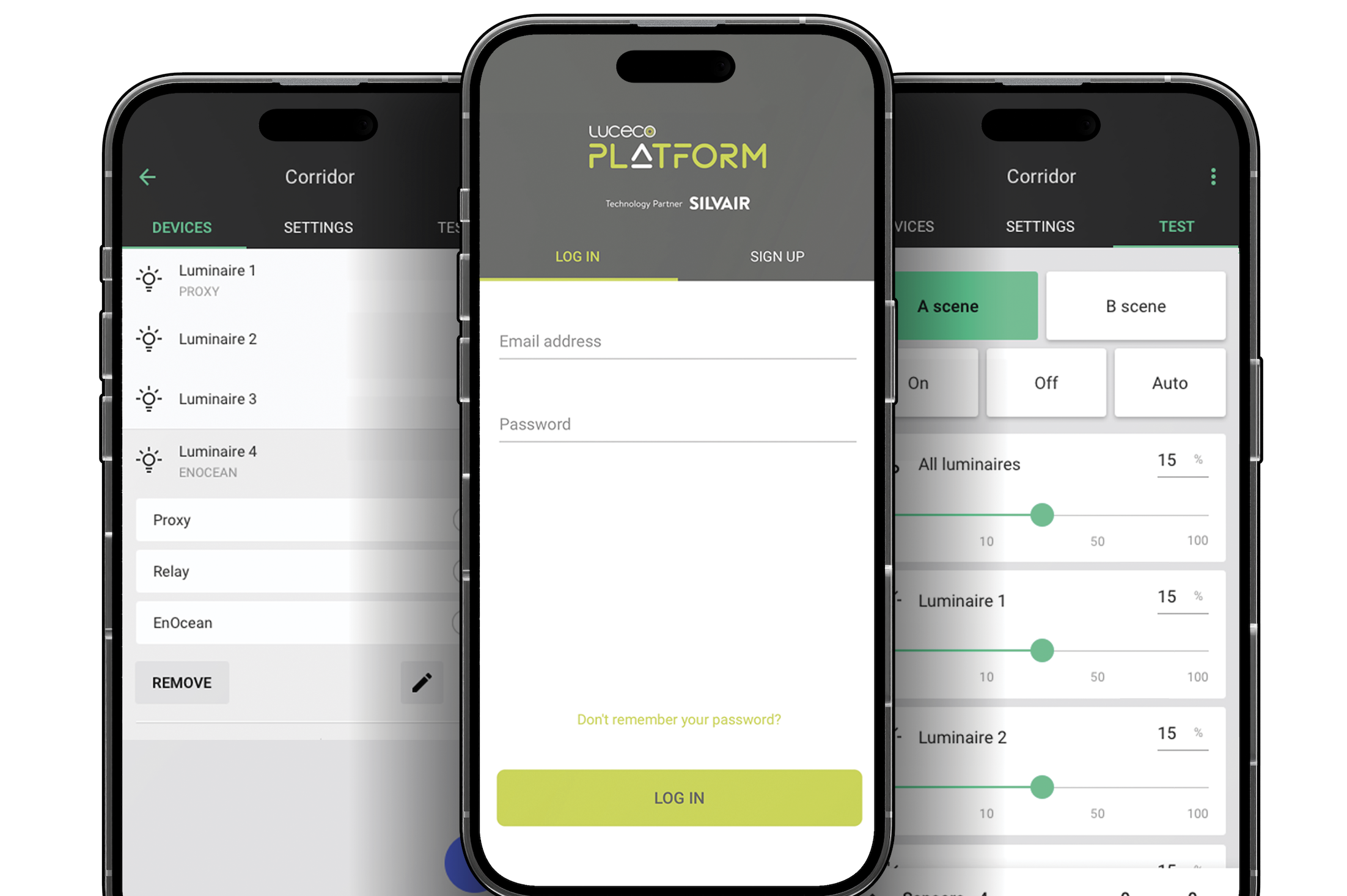
Another factor supporting the adoption of wireless controls is the development of commissioning and management tools. Historically, sophisticated lighting control could involve specialist knowledge and complex commissioning procedures. Modern systems are increasingly designed with intuitive software and mobile interfaces, enabling contractors to configure devices, establish zones and set control parameters without unnecessary complexity.
For contractors, this can make intelligent lighting more accessible. For wholesalers, it creates an opportunity to support customers with a solution that can be specified and supplied as part of a broader lighting package.
Luceco Platform brings together functions including occupancy sensing, daylight harvesting, dimming and scene setting, alongside emergency lighting testing. The system is designed to provide a scalable approach for both new-build and retrofit applications. Its partnership with Silvair combines Luceco’s lighting expertise with Bluetooth Mesh technology and an open, globally recognised approach to networked control.
An opportunity for the wholesale channel
With the growing importance of controls, the conversation between manufacturers, wholesalers and contractors is also changing. As lighting becomes more connected, the traditional distinction between a luminaire and its control infrastructure becomes less clear. A contractor may increasingly expect to source the products, connectivity and control functionality required for a project through the same supply chain.
This gives wholesalers an opportunity to add value beyond product availability. Understanding how lighting controls work, where wireless technology is appropriate and how a complete system can be configured can help distributors become an important source of technical support as well as product.
Importantly, it also reflects a broader change in what customers expect from lighting. Energy efficiency remains important, but the narrative is moving towards efficiency combined with flexibility, data, user comfort and long-term building performance. The ability to control lighting intelligently is therefore becoming less of an optional enhancement and more of an integral part of the specification. Wireless technology is helping to accelerate that transition by reducing some of the installation barriers associated with networked control.
For the electrical wholesale sector, the opportunity is to recognise that lighting is no longer simply about what illuminates a space. Increasingly, it is about how intelligently that space can operate.
As connected lighting continues to mature, systems such as Luceco Platform demonstrate how wireless control can bring together the practical requirements of installation with the longer-term demands of energy efficiency, adaptability and building management – creating a lighting proposition that extends well beyond the luminaire itself.