
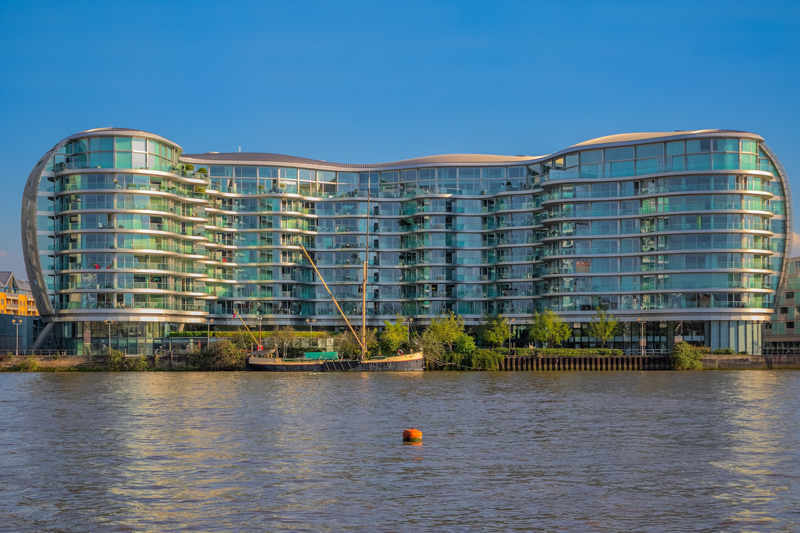
Modern, futuristic buildings come with modern, futuristic challenges. And when engineers need to think outside of the traditional control box, they turn to WAGO.
There was a lot to consider when integrated control system specialist, Accurro, started work on Albion Riverside, an 11- storey apartment block of shimmering glass overlooking London’s Thames.
“There is so much glass, it is like a greenhouse, so part of the scope was to overcome the heat gained from the sun. That was the biggest challenge,” explained Harry Lees, the company’s co-founder and director.
Accurro was also tasked, he said, with controlling the humidity in the building to safeguard the installed artwork, and extracting moisture from the building’s steam room when it wasn’t in use. The client also required leak detection, for insurance purposes, and for all controls to be as easy to use as possible.
Smart thinking
To fulfil the brief, Accurro installed a smart HVAC solution. It tracks the sun’s position in the sky and measures radiation levels in real time, then uses this data to automatically control air conditioning, heating, and humidifiers in individual rooms as the day progresses.
As well as meeting the client’s practicality requirements, this approach also contributes to the building’s overall sustainability by ensuring the efficient use of power. “Once the resident has set the system to the temperature they are happy with, it controls itself,” said Harry. “It means they always get the optimal energy usage.”
Controls and graphics are integrated into the installed touch screens, providing residents with a single, simple interface for audiovisual and HVAC functions, while an automatic extract damper extracts steam from the steam room.
Bullet sensor leak detection modules on the floor of the plant room raise the alarm if water is detected, or if pre-set usage parameters are exceeded, indicating a burst pipe. As well as protecting the building and its contents from damage, this further contributes to its green credentials by helping to avoid water waste.
Big ideas, small footprint
One of the biggest restrictions when designing the system was the size of the plant room. Harry explained that this was quite common in residential developments, where architects do not necessarily consider the space needed for advanced building management systems (BMS).
The solution, he went on, was WAGO’s 750 series programmable logic controller (PLC).
“Generally speaking, you wouldn’t use a PLC in residential building control – they are more for industrial applications,” Harry said, “but a normal BMS panel is about four times the size of the WAGO PLC.”
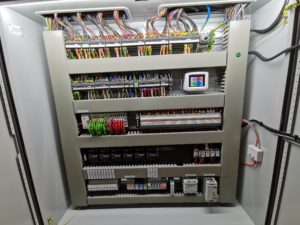
What’s more, because it is designed for industrial use, “it is very robust,” Harry went on, adding that the team also used WAGO terminals for underfloor heating manifolds.
“These are usually stuck behind cupboards,” he explained. “The WAGO clamp system means there are no screws on the terminals, so they are maintenance free – you don’t have to check the screws each year to make sure none are loose. This is a huge plus on residential properties.”
In addition, WAGO’s automation system is open source and vendor agnostic at field level. This, combined with the flexibility provided by the WAGO Codesys Software, this allowed Accurro to “put their own stamp” on the solution, and tailor it to meet the needs of their end user, Harry added.
Second-to-none support
During the year-long installation, WAGO were on hand to promptly answer questions and respond to queries. “When we contact the WAGO UK and Ireland systems support team, they pretty much always come back to me on the same day with a solution. They seem to know everything, and I have no idea how they remember it all.”
Looking ahead, Harry said Accurro would consider using WAGO’s PLC, rather than the traditional BMS approach, in future residential developments. “The form factor and the robustness make it ideal for this kind of project,” he concluded.
For further information, click here
Find more industry features here