
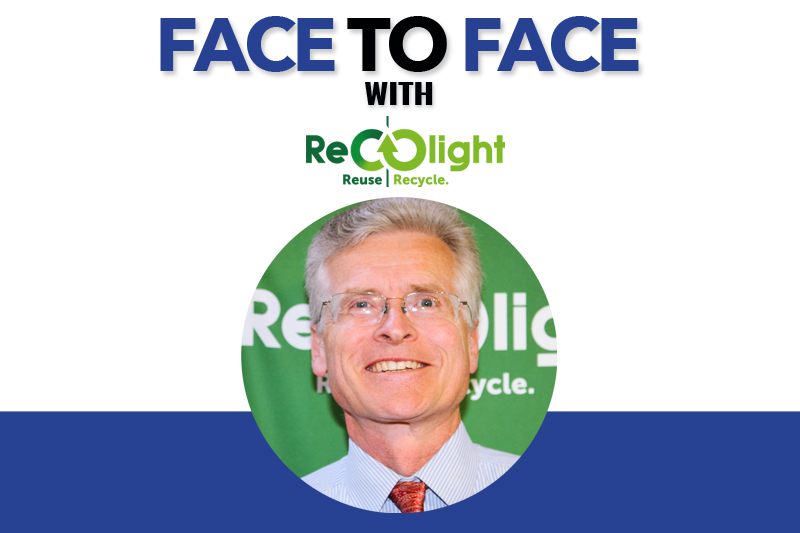
In this month’s Face to Face we speak to Nigel Harvey, Chief Executive at Recolight, to hear his views on a more sustainable lighting industry and the implementation of the circular economy.
Q. Why should electrical wholesalers offer a free lamp and WEEE recycling service to customers?
There are many good reasons. First and foremost, because it is a legal requirement: Any wholesaler selling electrical products that could be used by a consumer, must provide a free of charge take back on a one-for-one basis. So if, for example, an electrical contractor buys 50 GU10 LED lamps, they have the right to return around 50 similar lamps to the point of purchase, for recycling.
In addition, providing a WEEE take back service is a vital way in which wholesalers can act more sustainably. That also provides an additional service to their customers, and can increase footfall.
Q. What are Recolight and how can they help with this?
Recolight was set up by the lighting industry as a not-for-profit to provide collection and recycling of waste lighting to meet obligations under the WEEE regulations. That means Recolight offer wholesalers, and others, free collection and recycling of waste lamps, subject to minimum quantities. The company also provide low cost collection of waste luminaires and batteries.
Q. Why is the circular economy so important and what difference will the release of the Government’s ‘Circular Economy Growth Plan’ make?
The circular economy is a vital way in which sustainability can be embedded into commercial operations, and is an essential part of the effort to tackle climate change. A circular economy seeks to keep existing products in use for longer, to repair or upgrade them where possible, and to only replace and recycle them where that is not an option. The government set up a taskforce to make recommendations on how to implement a circular economy, and we expect to see a consultation on the proposals this Spring.

Q. How can wholesalers engage better with the circular economy?
The circular economy is about reuse, repair, remanufacture, and upgrade. There is a material opportunity for any wholesalers that can start to provide such services, either themselves, or in partnership with other organisations.
Q. Can you tell us a bit about what Recolight does?
Beyond providing collection and recycling of lighting, Recolight is extremely active in supporting the transition to a circular economy. So Recolight organise Circular Lighting Live, the UK’s only conference dedicated to the circular economy and the lighting industry. Recolight also sponsor Circular Lighting Report on LinkedIn, a news service celebrating all the sustainability achievements of the lighting industry. And the company also helps to ensure that unsold remaindered stock can be used in charities or other social enterprises rather than being recycled.
Q. What are EPDs and what EPD related services does Recolight offer to manufacturers?
Life Cycle Assessments (LCAs) and Environmental Product Declarations (EPDs) provide tangible ways in which manufacturers can accurately evidence the full sustainability of the products they sell. They therefore allow specifiers and end-users to choose products based on an independent third party verified statement of the environmental impacts of products.
Recolight provide a “one-off EPD” service that helps manufacturers prepare an EPD. That includes support in gathering the data required, entering it into the OneClick LCA platform, preparing a draft EPD, finalising it, and then submitting it to EPD Hub for independent verification. The service is subject to a flat all-inclusive fee.
Q. What can we expect to see from Recolight and the wider lighting industry in 2026?
Circular Lighting Live will be back again on 8th October 2026 in London, showcasing the latest developments and regulatory changes taking place in the circular economy. Prior to that, the Government will have consulted on possible changes to implement its circular economy growth plan, and the outcome of that consultation should be available. That will make Circular Lighting Live in 2026 the perfect opportunity to understand the planned changes, and consequences.
Find out more about Recolight here
Catch up on previous ‘Face to Face’ articles here