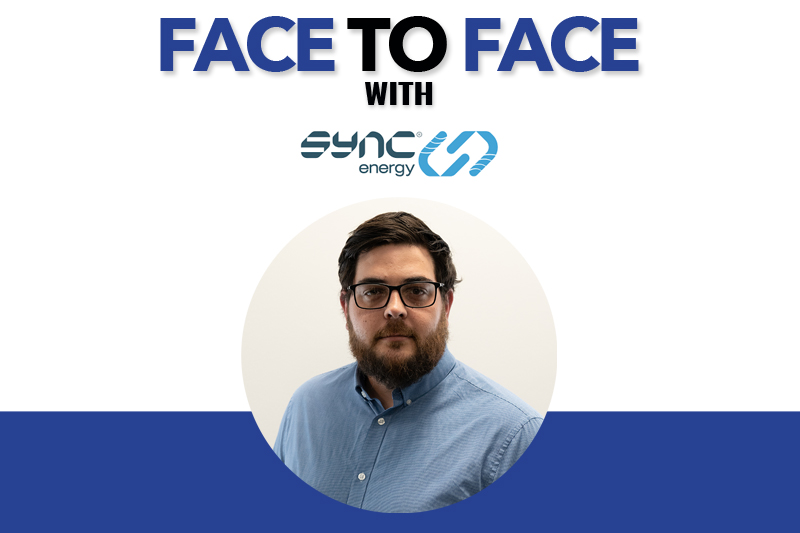
In this month’s Face to Face we speak with Robert Stuart-Walker, EVCP NPD Manager at Sync Energy, and find out more about the future of the EV market.
How and when was Sync Energy established?
Sync Energy began life as Sync EV, which was founded in 2009 with a very clear focus on practical, installer-friendly solutions. In 2022, the business was acquired by Luceco Group, which marked a real turning point for the brand. That acquisition brought broader engineering, compliance and manufacturing capability, alongside long-established relationships across the electrical wholesale and contractor market.
In 2024, the brand evolved from Sync EV into Sync Energy. That change was about more than just a new name. It reflected a wider ambition. EV charging was no longer seen as a standalone product, but as part of a connected home energy system that can include inverters, battery storage, solar power diverters, smart apps and smart tariff integration.
Throughout those transitions, one thing has remained consistent, putting installers first. Every product decision is driven by how easy it is to install, set up and hand over. That runs from intuitive wiring layouts and flexible mounting options through to clear commissioning steps and an app that installers can confidently walk customers through at the end of a job.
The goal has always been to make installations simpler, reduce call-backs, and help installers deliver a better overall experience for their customers.
How do you see the future of the EV charging market?
The market is moving quickly from “can I charge at home?” to “how do I charge smarter?”. Hardware will always matter, but software, connectivity and energy awareness are becoming just as important.
Looking ahead, EV chargers will increasingly sit alongside home energy management systems and need to interact with smart tariffs. The challenge is making those systems work together without adding complexity for installers.
EV chargers are becoming a critical part of grid stability locally and nationally to avoid spikes of grid power requiring less renewable energy sources.
Our approach is to offer a simple, connected solution where everything can be managed through one easy-to-use app. That avoids complex commissioning processes and the need for multiple apps to control home energy and EV charging.
What are some of the built-in features that are making EV chargers smarter and more powerful?
Connectivity is a big one. App-based control allows users to schedule charging, track energy usage and understand costs far more clearly. From our perspective, those features also need to be quick and straightforward for installers to set up and test before leaving site.
Tariff awareness, solar integration and smarter load management are becoming standard expectations, but we are careful to design them in a way that doesn’t overcomplicate installation or handover. If an installer can’t explain a feature in a couple of minutes, we see that as a design problem, not an installer problem.
What are some of the key considerations when selecting an EV charger for home or commercial use?
Reliability and compliance come first, particularly from an installer’s point of view. Contractors need confidence that a product will perform as expected and won’t lead to unnecessary call-backs.
Ease of installation is another major factor. Simple Wiring, flexible mounting options and a logical commissioning process make a real difference on site. For homeowners, usability is key, but that starts with how easily the installer can get everything set up in the first place.
In commercial settings, PAS accessibility compliance, scalability and monitoring become more important, but the same principle applies. If a system is easy for an installer to deploy and manage, it is usually easier for the end user too.
What is the Flow Energy Management System?
Sync Energy Flow is our complete home energy management system, designed to give homeowners clear, intelligent control over how energy is generated, stored and used in the home. At its core, Flow brings together hybrid inverters, modular battery storage, EV charging and solar power diverters, all managed through the Sync Energy app.
The idea is simple. Rather than elements of the home energy system working in silos, Flow allows everything to work together. Solar generation, battery storage and optional EV charging are all controlled in one place, making it easier to maximise energy use.
For homeowners, Flow offers the flexibility to grow the system over time as their needs change. For installers, it has been designed to be straightforward to specify, install and expand, with modular components that help reduce complexity on site.
Flow isn’t about adding unnecessary technology. It’s about giving people smarter control, future-proofing home energy setups, and making the move to more sustainable living easier for both installers and end users.
What are Sync Energy’s long-term aims and objectives?
Long term, our focus is on supporting the transition to smarter, more flexible energy use, while continuing to put installers at the centre of everything we design.
That means investing in products that are quicker to install, simpler to commission and easier to support once they are in the field. We are constantly looking at ways to reduce friction on site, whether that’s through clearer documentation, better app workflows or smarter product design.
For Sync Energy, it’s about delivering a complete, connected solution that makes sustainable charging accessible, practical and installer friendly.
Find out more about Sync Energy here
Catch up on previous ‘Face to Face’ articles here